
In the rapid evolution of the Silicon Valley AI landscape, 2026 marks the definitive transition from "Large Language Models" to "Autonomous Reasoning Engines." As a Senior IT Solutions Architect, the question is no longer "which model is smarter," but rather "which architecture minimizes technical debt while maximizing operational throughput."
The rivalry between Google’s Gemini 3 Pro and OpenAI’s GPT-5.2 has moved beyond simple benchmark wars. We are now looking at two fundamentally different philosophies of intelligence: Gemini’s Breadth vs. GPT’s Depth.
1) The Logical High Ground: GPT-5.2 and the "Reasoning" Hegemony
OpenAI’s GPT-5.2 represents the culmination of the "Thinking Mode" paradigm. Unlike the probabilistic next-token predictors of years past, GPT-5.2 utilizes an advanced System 2 thinking process—a deliberate, multi-step reasoning protocol that iterates on a problem before outputting a single word.
For IT infrastructure and high-level software engineering, this is a game-changer. When tasked with refactoring a legacy microservices architecture or identifying a race condition in complex asynchronous code, GPT-5.2 doesn't just suggest a fix; it simulates the execution path. The Hardened Security protocols integrated into GPT-5.2's reasoning loop ensure that code suggestions are automatically audited against the latest 2026 CVE (Common Vulnerabilities and Exposures) databases.
Key Strength: Systemic Logic. If your workflow requires high-stakes decision-making where accuracy is non-negotiable—such as financial modeling or cloud security auditing—GPT-5.2 remains the industry gold standard. Its ability to maintain "logical coherence" over thousands of steps of a complex prompt is currently unmatched.
2) The Context King: Gemini 3 Pro and the Death of RAG
While OpenAI went deep, Google went wide. Gemini 3 Pro’s headline feature in 2026 is its staggering 2.5 Million Token Context Window with near-perfect retrieval. This has fundamentally disrupted the RAG (Retrieval-Augmented Generation) industry.
In previous years, we spent millions of dollars building complex vector databases and chunking strategies to feed AI relevant information. Gemini 3 Pro makes most of that obsolete. You can now drop an entire 50,000-page technical documentation library, the complete source code of an enterprise ERP system, and ten hours of high-definition video logs into the context window simultaneously.
Key Strength: Global Information Synthesis. Gemini 3 Pro’s ability to "see" the entire project at once allows for a level of cross-referencing that GPT-5.2 struggles with due to its more restrictive (though highly optimized) context management. Furthermore, its Native Multimodality—the fact that it was trained on video, audio, and text as a single interleaved stream—makes it the superior choice for analyzing CCTV feeds, server room audio diagnostics, or complex UI/UX video walkthroughs.
3) Implementation Logic: The Hybrid Workflow
For a high-availability enterprise environment, the choice isn't binary. We are seeing a "Best-of-Breed" hybrid implementation becoming the standard SOP.
3.1) The "Architect's Workflow" Logic:
4) Performance Metrics & Token Economics
In 2026, the "Cost per Intelligence" (CPI) is a critical KPI for any CTO.
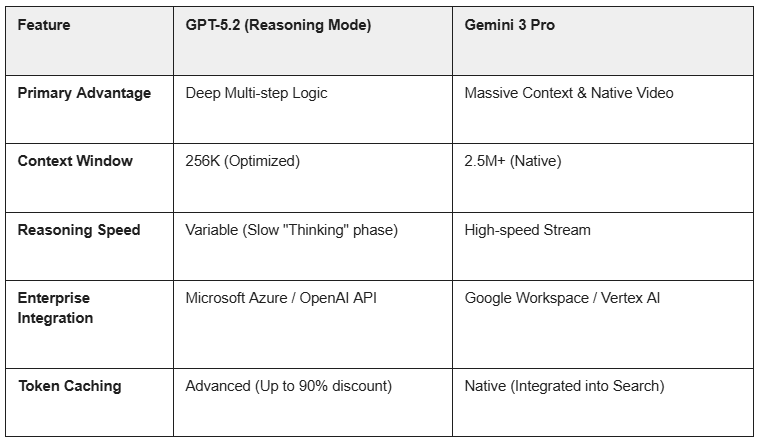
Cost Considerations: GPT-5.2 is more expensive per million tokens but requires fewer iterations to reach a "correct" complex answer. Gemini 3 Pro is cheaper for massive ingestions but can occasionally drift into "laziness" if the prompt isn't strictly bounded within its context.
5) The Infrastructure Verdict: Digital Sovereignty
For the "InquiryLab" mindset, the choice often boils down to Digital Sovereignty. GPT-5.2’s architecture is increasingly "black-box," making it difficult to audit the exact reasoning path. Gemini 3 Pro, through Google’s Vertex AI "Hardened VPC" (Virtual Private Cloud) deployments, offers slightly better transparency for enterprise compliance (GDPR/CCPA 2026 updates).
If you are building for Scale and Data Synthesis, Gemini 3 Pro is your backbone. If you are building for Accuracy and Complex Automation, GPT-5.2 is your brain.
Back to top
Comments